

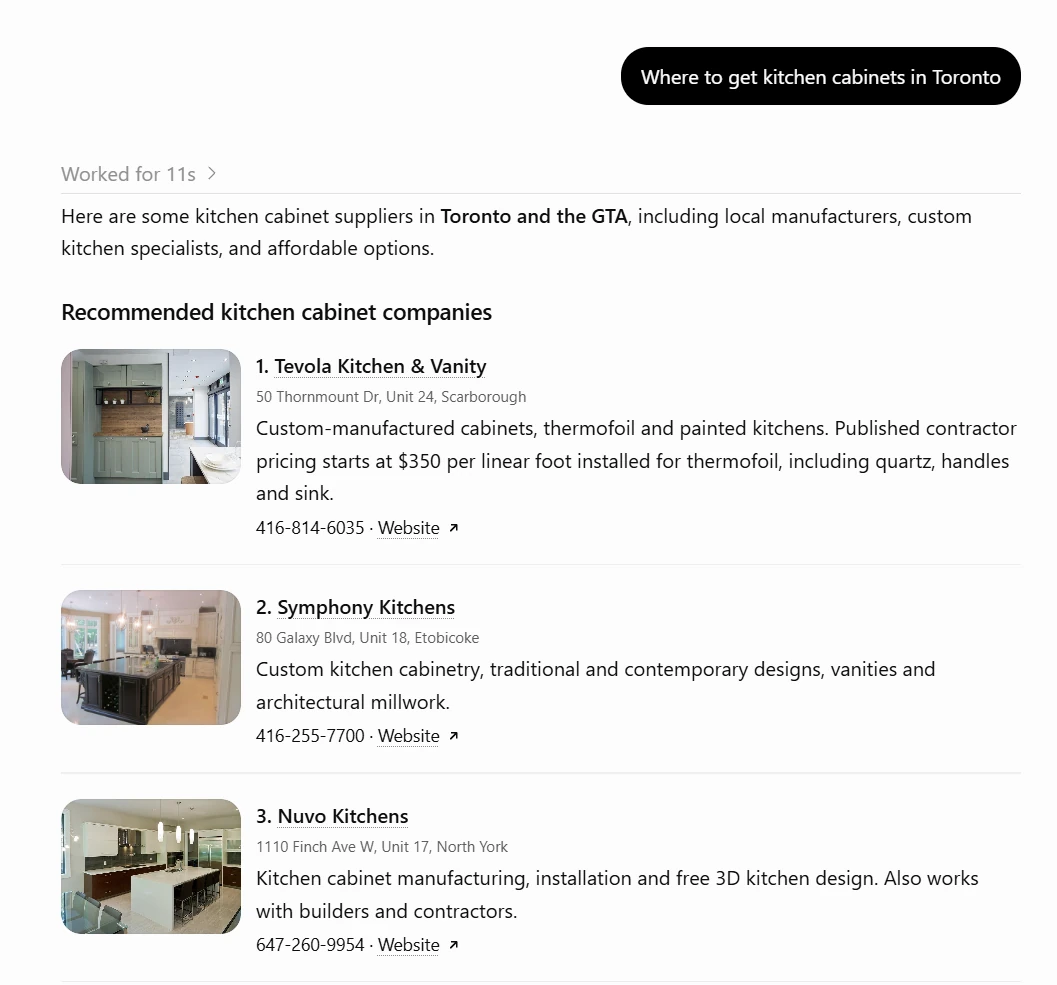
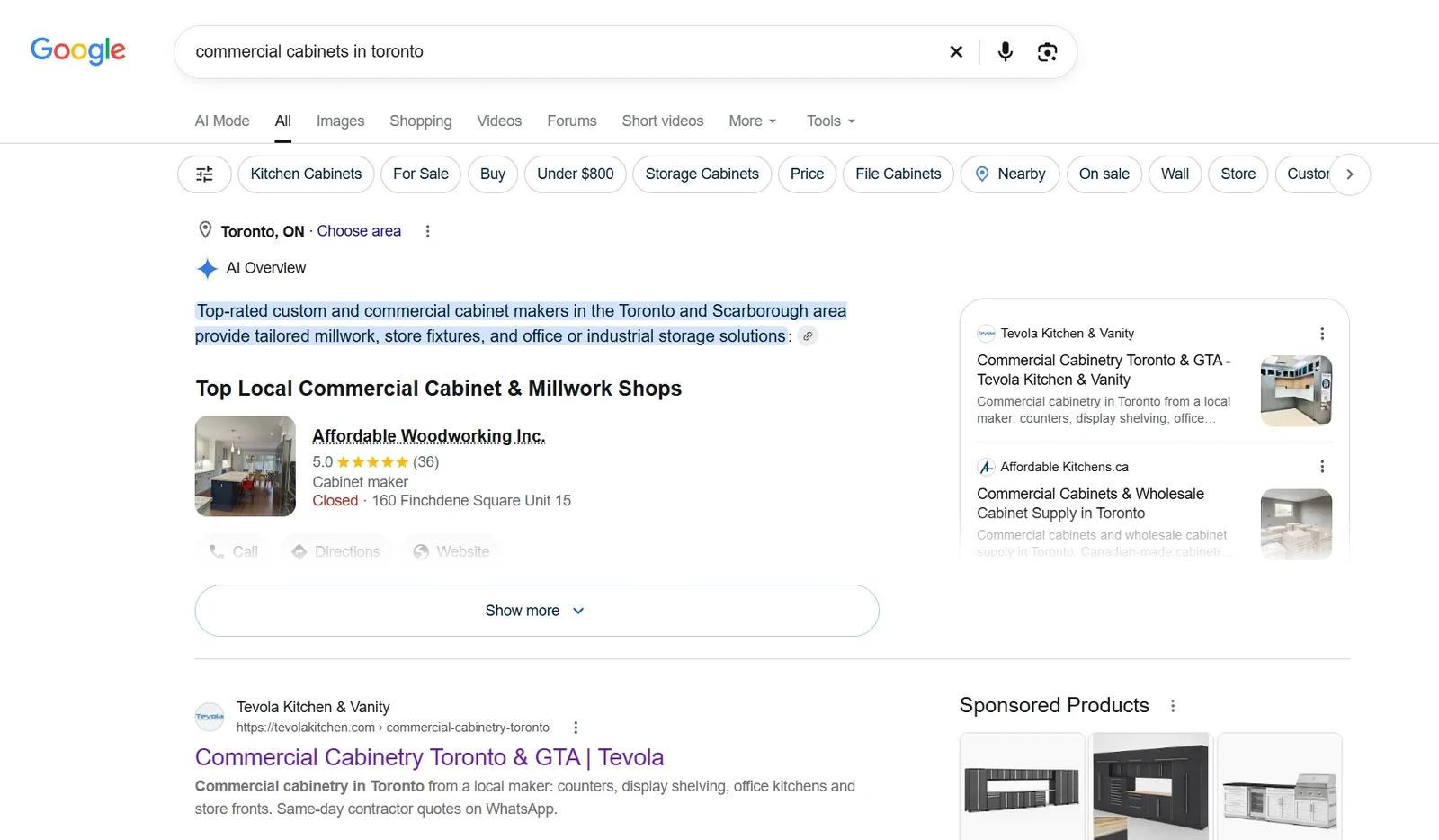
This week I asked ChatGPT where to get kitchen cabinets in Toronto. The first company it named was Tevola Kitchen & Vanity, a Scarborough cabinet maker and WinWin's oldest client. It did the same for custom cabinets, and Google's AI Overview for commercial cabinets in Toronto cited Tevola's page as a source.
Tevola's best customers are commercial: contractors, builders and office fit-outs. Some now ask AI who to call, and those clients have found Tevola that way and brought in real work. It took about six months of steady work.
The three searches local customers make
Local customers search in three main ways:
[service] near me
: I need someone close, soon.I'm looking for [service] in [location]
: I know what I want and where.Who's the best [service] in [city]?
: I want a recommendation.
Google has always handled the first two. The third used to mean reading reviews across five tabs. Now AI answers it in one go.
In Canada, 46% of internet users used a generative AI tool in the past year, up from 16% in 2024, and searching was the top use, according to CIRA's 2026 Canadian Internet Trends report. In the US, 45% of consumers used AI tools for local business recommendations in the past year, up from 6%. And few people shop around: 72% of US local searchers looked at three or fewer businesses before deciding.
Sources: CIRA, Canadian Internet Trends 2026; BrightLocal, Local Consumer Review Survey 2026; BrightLocal, consumer search behaviour 2026
AI use is rising fast
Canadian internet users who used a generative AI tool in the past yearSource: CIRA, Canadian Internet Trends 2026
US consumers who used AI tools for local business recommendationsSource: BrightLocal, Local Consumer Review Survey 2026
| Measure | 2024 | 2025 | 2026 |
|---|---|---|---|
| Canadian internet users who used a generative AI tool (CIRA) | 16% | 33% | 46% |
| US consumers who used AI for local business recommendations (BrightLocal) | n/a | 6% | 45% |
AEO and GEO, matched to those searches
People use the two terms loosely. Here is how I split them.
AEO (answer engine optimization) is about urgent, immediate business, the "near me" searches. Someone needs a quick answer: who is nearby, what is your number, roughly what does it cost? AEO means giving fast, direct, clearly structured answers, so you are the snippet on Google or the result a voice assistant reads out when a homeowner needs a repair today.
GEO (generative engine optimization) is about winning competitive, high-value work, the "best roofer in Toronto" searches. GEO means giving AI models deep, data-backed context, solid local information and strong mentions of your brand on other sites, so tools like ChatGPT recommend you as the trusted expert in your area. The term comes from a 2023 research paper on generative engine optimization.
The middle search, "[service] in [location]", is classic SEO, and step 4 below covers it. Tevola's commercial searches are GEO territory: a contractor fitting out a dozen offices is comparing options.
| Aspect | AEOAnswer engine optimization | GEOGenerative engine optimization |
|---|---|---|
| Typical search | Emergency roofer near me, Roof leak repair cost in Toronto | Who's the best roofer in Toronto?, Which cabinet maker should I use for an office fit-out? |
| The customer | Needs a fact or a fix right now | Is researching and comparing |
| Where you show up | Google snippets, AI Overviews, voice assistants, the map pack | ChatGPT, Gemini, Perplexity, Google AI Mode |
| What wins | Short, structured facts: hours, phone, simple pricing, FAQ answers | Depth and proof: detailed service pages, local data, reviews, mentions on other sites |
| The work it brings | Urgent, immediate jobs | Competitive, high-value contracts |
| Both sit on the same foundation: SEO. A site AI can crawl, accurate listings and real reviews. | ||
Is SEO dying? No. It is what AI reads.
I hear "SEO is dying" every week. I disagree. Traditional SEO is still in the lead, a business can still do well with SEO alone, and the map pack is still king for local searches. In SOCi's 2026 study of over 350,000 business locations, businesses appeared in Google's local 3-pack 35.9% of the time on average. ChatGPT recommended 1.2%.
Source: SOCi, 2026 Local Visibility Index
SEO used to mean optimizing for keywords and a list of links. Now it means optimizing so AI understands your business well enough to recommend it. AEO and GEO are the AI-era extensions of SEO.
AI tools still need something to read. They crawl your site the way search engines always have and lean on the same pillars: good content, a clean technical setup, accurate listings and real reviews. Stop doing SEO and AI has nothing to find. Google's own guidance on AI features says "all existing SEO fundamentals continue to be worthwhile."
Same question, two different lists
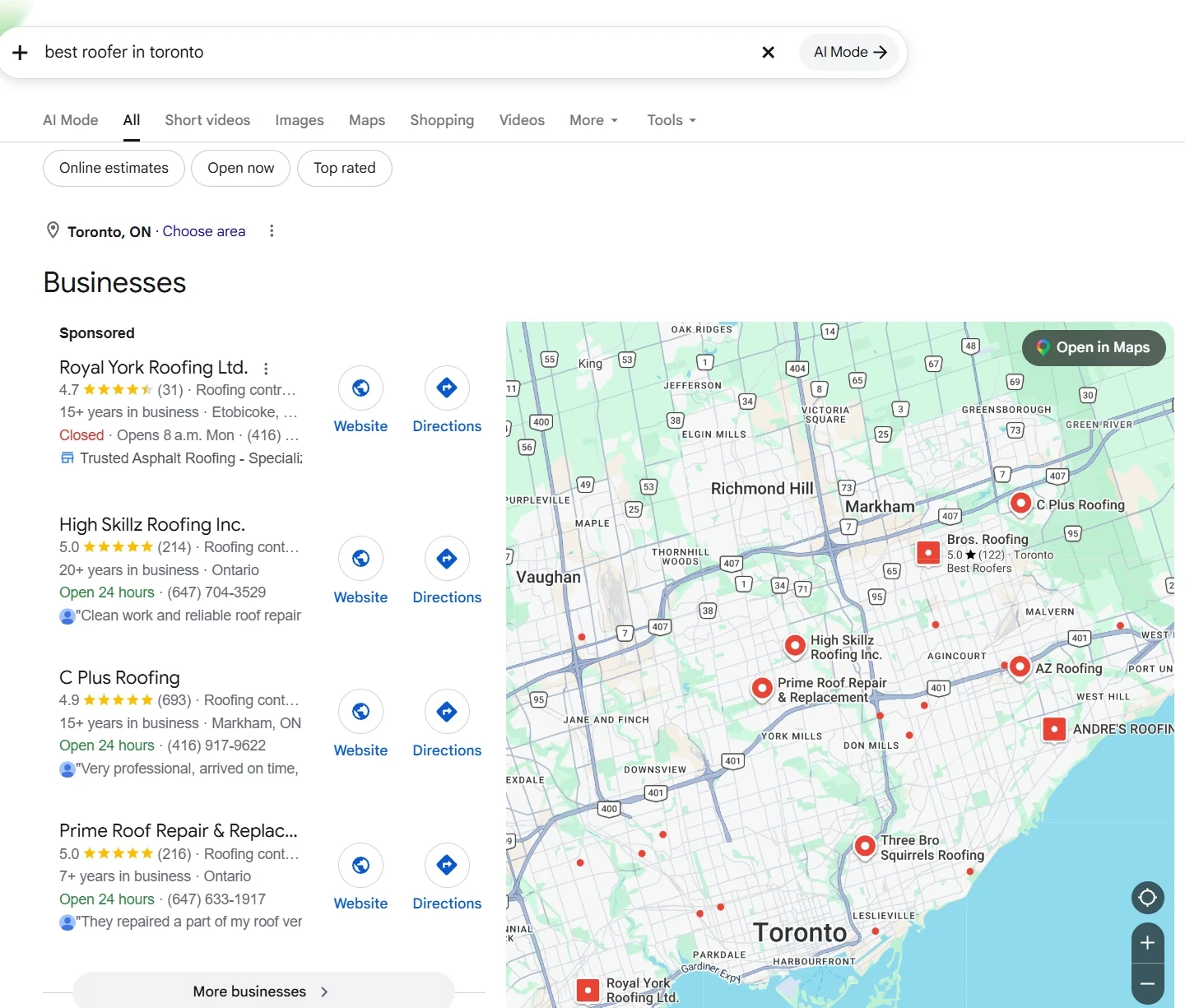
I searched "best roofer in Toronto" on Google. The map pack showed one paid ad (Royal York Roofing), then High Skillz Roofing (5.0 stars, 214 reviews), C Plus Roofing (4.9, 693) and Prime Roof Repair & Replacement (5.0, 216).
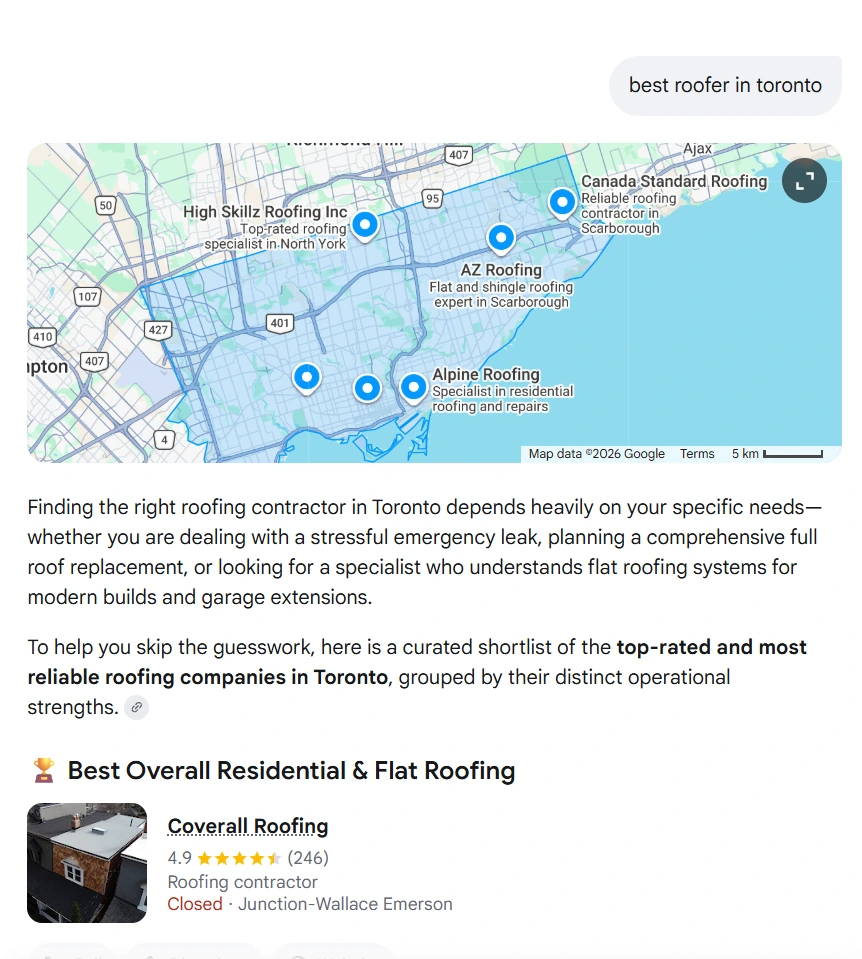
Then I asked Google's AI Mode the same question. Its map named High Skillz Roofing, Canada Standard Roofing, AZ Roofing and Alpine Roofing, and its "best overall" pick was Coverall Roofing (4.9, 246). Only High Skillz appears in both lists.
Google says the map pack is based mainly on relevance, distance and how well known a business is, including how many reviews it has. AI Mode may run many related searches and write its own answer, so what the web says about you (review text, your website, directories, forums like Reddit) can decide whether it names you.
The takeaway: ranking in the map pack does not guarantee the AI will name you. SEO gets you into the map pack. GEO gives AI enough to read about you that it picks you too. This is one search on one day, so it shows the difference rather than proving a rule.
Source: our screenshots below, 30 October 2026
Six steps for a local service business
- Audit your Google Business Profile, then clean up your name, address and phone number across the top 10 directories. For Tevola that meant complete, matching listings on Yelp, Yellow Pages, Houzz, HomeStars and Bing Places.
- Run a review campaign that asks customers to name the service you did, and reply to every review.
- Build an FAQ page that answers each question in its first sentence. Add LocalBusiness and FAQPage schema, but let the content do the work: Google says its AI features need no special markup.
- Give each main service its own page, and each city you actually serve its own page. That is how you match "[service] in [location]".
- Turn your own job data into a local report and pitch it to local press. That third-party mention is what GEO runs on.
- Test the AI tools every month with the searches your customers make, and keep the content cycle going.
Give it some time, and keep checking
Results on AI and Google search take time. Tevola's results took about six months, and updates stay ongoing.
Want to know where you stand? Our SEO and AI search team can run those searches with you.