


Everyone in tech knows software has holes. What kept most websites safe was effort. Finding a serious flaw meant a skilled person reading code for weeks or months, so old holes stayed hidden for years, and a small business website was rarely worth the trouble.
This year that changed. AI found a flaw that had been sitting in the language behind most of the web for 14 years, and as soon as the fix went public, attackers went after sites that had not installed it. In our post on AEO and GEO, we wrote about how AI is changing the way customers find you. But this story shows how AI changes the way attackers find you.
What is PHP? PHP is the programming language that runs on a website's server. It builds each page and handles things like logins and forms. Many website platforms like WordPress are built on it, and custom websites use it for server management.
What happened
On 21 October, PHP released emergency fixes for two critical flaws in PHP itself, now called PHP2Shell. PHP runs WordPress and about 70% of websites whose server language is known. The flaws let someone with no login run their own code on your server. Because the problem is in PHP, not in a plugin or theme, it does not matter what is built on top.
The flaw had been in PHP for 14 years, according to OpenAI president Greg Brockman. Two security firms found it separately with AI: Calif in early August using OpenAI's GPT-5.6 Sol, and Wiz weeks later using Google's Gemini 4 Argon and GPT-5.6 Sol. Wiz says one researcher working with AI did in a week "what previously would have taken a world-class team months of work."
Sources: Wiz Research, 21 October 2026; Fortune, 21 October 2026; W3Techs, 2 November 2026
The PHP2Shell timeline, August to October 2026
Found and reported
- AI finds the flawSecurity firm Calif spots it
- Wiz reports itTo PHP's security team, after also finding it with AI
Under attack
- First attacksAmazon sees attempts, four days before the fix
- Details leakWord of the flaw gets out online
- Fix releasedAttempts reach the millions by the next day
- Governments warnThe US and Canada confirm it is being exploited
The attacks started before the fix
Details leaked online on 20 October, and Amazon says it saw the first attempts on 17 October, four days before the fix was out.
Things only got worse from there. Cloudflare's CEO, Matthew Prince, said its network saw thousands of attempts in the 10 hours before the announcement, "tens of thousands in the 45 minutes post announcement," hundreds of thousands within two hours, and millions by the next day.
By 27 October, the Canadian Centre for Cyber Security was warning that internet-facing PHP servers are at "heightened risk."
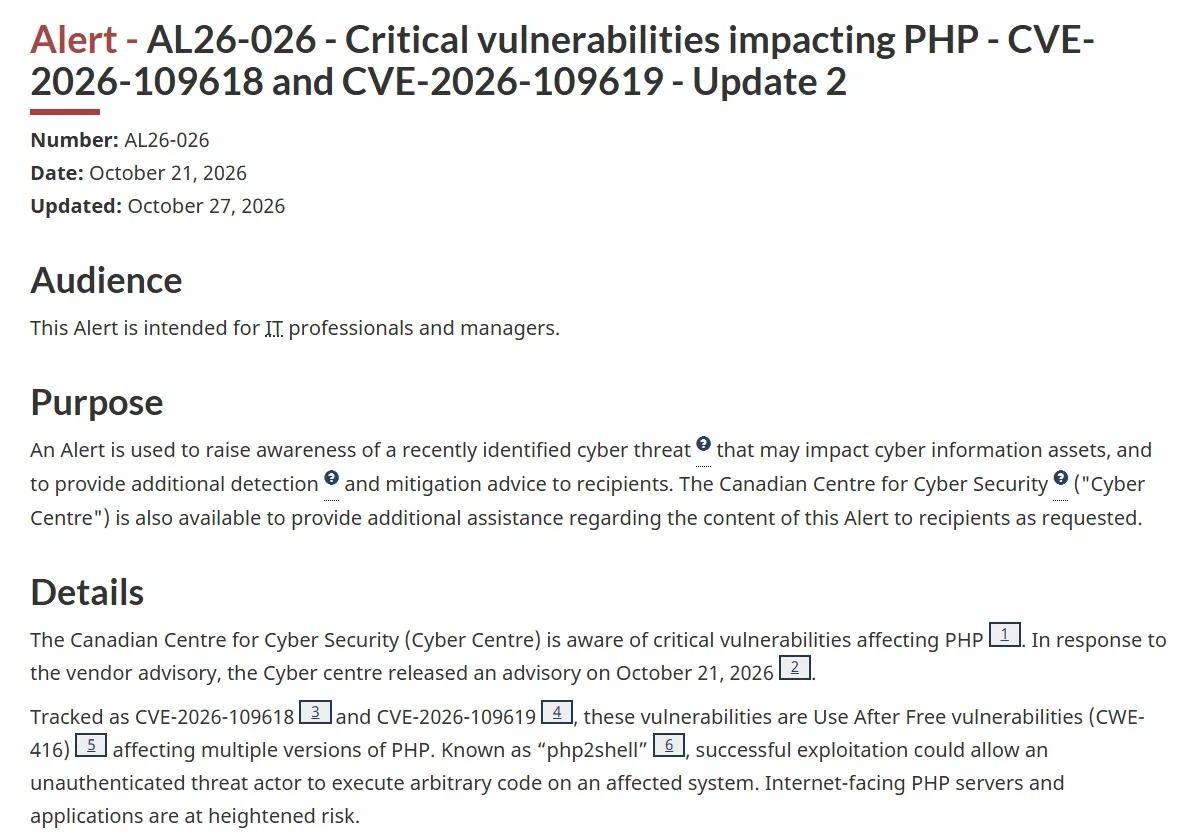
If you heard about PHP2Shell a day late, millions of attempts had already been made. The video below by Anton Putra walks through that week, day by day, and explains what you can do about it.
Sources: BleepingComputer, 22 October 2026; The Next Web, 23 October 2026; Canadian Centre for Cyber Security, AL26-026, updated 27 October 2026
Why this changes website security
Security used to lean on how slow and expensive it was to find a hole. AI removes most of that cost. It reads code fast, tests ideas around the clock and works on many problems at once. When Anthropic stopped an AI-run hacking campaign in 2025, it said the AI did 80-90% of the work and made "thousands of requests, often multiple per second," a pace it said human hackers could not match.
Two kinds of websites are most exposed:
- Old code. PHP 8.1 and older get no official fix for PHP2Shell, and about a third of PHP websites still run PHP 7 or older.
- Code nobody checked. Sites built fast with AI coding tools, often called vibe coding, tend to go live with holes. In a 2026 study of 200 live apps built with Claude Code and Lovable, 91% had at least one vulnerability, and about two thirds of the flaws were rated critical or high. Once a site like this is public, anyone with the right AI tools can find holes and access it.
Sources: Anthropic, 13 November 2025; W3Techs, 2 November 2026; Deng, Fan and Meng, arXiv, revised September 2026
It isn't just PHP
- In October, Next.js, the framework behind many modern websites, shipped an emergency fix for two flaws rated 9.5 out of 10 for severity, before any attacks were reported. A week later Node.js, which Next.js runs on, fixed its own, nicknamed Node2Shell.
- In April, Anthropic's Claude Mythos Preview found a 27-year-old flaw in OpenBSD, a famously secure operating system, that let anyone crash a machine by connecting to it.
- Mandiant's 2026 report estimates the average time to exploit a flaw is now minus seven days, and attacks routinely start before a fix even exists.
Sources: Next.js, 14 October 2026; Cyber Security Agency of Singapore, 20 October 2026; The Hacker News, 15 October 2026; Node.js, 21 October 2026; CSO Online, 27 October 2026; Anthropic, Project Glasswing, 7 April 2026; Google Cloud, M-Trends 2026, 23 March 2026
How to protect your website
You will not out-hack AI. You can stay secure. Here is what we did, and what to do:
- Know what your site runs on. Ask your developer or web host which platform, which language, and which version. If it is WordPress, it runs on PHP.
- Use any quick safeguard first. Ask your developer. We applied a temporary fix to every PHP server before the full update.
- Update PHP itself. Keeping WordPress, themes and plugins updated still matters, but it does not fix PHP2Shell. The PHP version on the server has to change, and on most small business sites your web host handles that.
- Test before you switch. We compared each updated server with the live site, with an automatic undo ready.
- Get off unsupported versions. On PHP 8.1 or older? Plan the upgrade now.
- Turn on automatic security updates. Most of our PHP servers now install fixes on their own.
- Put a firewall in front of your site. Services like Cloudflare buy you time while you patch. They are not the fix.
- Lock down your logins. Use two-factor login, limit who can reach your admin page, and delete unused plugins.
- Follow the news, and name who acts. Sign up for alerts from the Canadian Centre for Cyber Security, and make one person responsible for acting the same day.
- If AI helped build your site, have a developer check it before launch, especially logins, who can see what, and where passwords and keys are stored.
AI will keep finding old holes faster, for defenders and attackers alike. Being protected used to mean updating when you got around to it. Now it means acting the day the news breaks.